Monday, April 11, 2011

Research: 5 categories in sound effect

(WEEK 5
Hard Effects – Of the five primary types of sound effects in filmmaking, hard effects are the most typical. These are distinctive sounds such as a car horn, a gunshot, or the slamming of a car door. With hard effects, there is usually a fixed sound connected with the picture; for example, a trigger is pulled and the sound of a gunshot is heard. In such instances, intricate synchronizing of sound to performance – as is necessary with footsteps for instance – is usually not required to evoke realism. 

Foley Sound Effects – These sound effects are recorded live by Foley artists and added postproduction to a movie to enhance both its audio quality and believability. Foley is the process of synchronizing sounds with on-screen action. Of all the different Foley sound effects, footsteps are the most common and well known. However, a Foley artist’s craft goes well beyond synchronizing the sound of footsteps to its action on screen. When you hear the realistic whooshes, whacks, and whirls of a fight scene or the clinking and clanking of silverware and dishes in a dinner sequence, you can be certain that a Foley artist worked behind the scenes adding these sound elements to heighten the movie’s realism. 

Background Effects – These sound effects, also called ambiences, lend reality to a movie by giving it a sense of location. For example, if you were to watch a movie with a scene of two people talking on a busy New York City street, you would hear the honking of horns and the sound of traffic in the background. It should be noted that background effects (BG) are not directly correlated with a specific onscreen action. Even though car horns were heard in the background in the example above, if one of the individuals conversing on the city street were to get in his car and honk the horn (a sound occurs due to a specific onscreen action), this would be considered a hard effect not a BG. 

Electronic Sound Effects – If you’ve ever watched a 1960’s sci-fi movie, you probably heard an example of an electronic sound effect. These effects were initially created with synthesizers and keyboards. Today, with the creation of DAW (Digital Audio Workstation) plug-ins, electronic sound effects are also created from filtered or processed organic sounds. These effects are often used as production elements for movie trailer sound beds and title elements on commercials and television shows. 

Design Sound Effects – There may be a sound or sounds needed in a film to assist in building suspense or creating a sense of reality that would be impossible to record naturally (such as the delicate metallic sound of a pin hitting a tiled floor). In such instances, the services of a sound designer – that typically uses a Digital Audio Workstation – would be required to create the desired sound(s). 

Under Creative Commons License: Attribution

Examples of scary sound effects

(WEEK 5)


Research: Scary Sound Effects links

(WEEK 5)Door Sound effects

Horror Sound effects

Halloween sound effect

Research: All About Scary Sound Effects

(WEEK 5)

Halloween music and scary sound effects are great for creating an atmosphere and setting the mood of any party that you host. It can be obtained for cheap or for free so it need not hurt your wallet to go this extra step and it is well worth it when you see the looks on people's faces!

There are two different types of scary sound effects you can use. The first is the scary sound effects that are popular in horror films and haunted houses. The other is to go with classic Halloween music. I prefer the latter because they tend to be more enjoyable and have actual melodies and harmonies. However, if you're going for the quick jump scare.then the sound effect would probably be the best bet for you you.

Let's take a look at some of the best representations of scary sound effects. We'll even discuss some of the best bands like Midnight Syndicate and Nox Arcana. If you're planning on hosting a Halloween party or are putting together your own haunted house attraction then these scary sound effects suggestions will hopefully come in handy for you.

Scary Sound Effects and Classics 

Scary Sound Effects ClassicsSound Effects - It is arguable as to whether mostHalloween music is actually "music" at all. Much of the stuff that you will find does not even feature any notes or melodies. While a great score in a movie can definitely build tension and anticipation, this can be quite hard to match to your own scene e.g. if you are trying to create a mini haunted house for the local kids then music might distract from the overall theme.

Classics - There are many songs that have become instant Halloween hits and help send a load of royalties the way of the artists at this time each year. Some of the best songs are Ghostbusters as well as Thriller by Michael Jackson. I'm sure you can think of several others too.

Scary Sound Effects Recommendation - Midnight Syndicate 
scary sound effects midnight syndicateIn my opinion Midnight Syndicate is the best band in the world when it comes to writing scary soundeffects and scary Halloween music. In reality, Midnight Syndicate write classical music that can be incorporated into virtually any horror setting. Their music provides a genuinely creepy atmosphere that will make your skin crawl.

Midnight Syndicate has been considered by many to be the first Halloween band or a Haunted House band. Their music has been featured in haunted attractions all over the world in places such as Siberia, Hong Kong and more. Their music is also great to sit back and listen to. Just make sure you keep the lights on if you're listening to them just to listen to them. Pretty soon there will be a chill in the air and the fear will swallow you.

http://www.squidoo.com/scarysoundeffects

Research: Sound Effects Function Category

(WEEK 5)


Some research on Sound Effect

(WEEK 5)Some Type of screams

Wilhelm scream 

The Wilhelm scream is a film and television stock sound effect first used in 1951 for the film Distant Drums.[1] The effect gained new popularity (its use often becoming an in-joke) after it was used in Star Wars and many other blockbuster films as well as television programs and video games.[2] The scream is often used when someone is shot, falls from a great height, or is thrown from an explosion.
The sound is named for Private Wilhelm, a character in The Charge at Feather River, a 1953 western in which the character is shot with an arrow. This was believed to be the third movie to use the sound effect and its first use from the Warner Brothers stock sound library.[3]

Howie scream
The Howie scream (also known as the Howie Long scream or Screams 3; Man, Gut-wrenching Scream And Fall Into Distance [1]) is a frequently-used film and television stock sound effect for a scream. Believed to have originated in 1980 as a sound effect in the movie The Ninth Configuration[1], the sound effect is featured as Screams 3; Man, Gut-wrenching Scream And Fall Into Distance in a Hollywood Edge sound library called The Premiere Edition[2]. Often compared to the Wilhelm scream, its prominence in a number of movies has given it a few nicknames such as Howie Long Scream, in reference to Howie Long's death scene in the movie Broken Arrow[3], and the TIE Fighter scream, for its similarity to the sound the passing fighters make in the 1977 film Star Wars Episode IV: A New Hope.
It also been used in video games such as Half-Life 2[4] as a faster version called the "Fast Zombie Yell", and Starcraft.

Sunday, April 10, 2011

Motion Detector

(WEEK 5)


MOTION DETECTOR
+ A motion detector is a device that contains a physical mechanism or electronic sensor that quantifies motion that can be either integrated with or connected to other devices that alert the user of the presence of a moving object within the field of view.

+ An electronic motion detector contains a motion sensor that transforms the detection of motion into an electric signal. This can be achieved by measuring optical or acoustical changes in the field of view. Most motion detectors can detect up to 15–25 meters (50–80 feet).
+ A motion detector may be connected to a burglar alarm that is used to alert the home owner or security service after it detects motion. Such a detector may also trigger a red light camera or outdoor lighting.
+ An occupancy sensor is a motion detector that is integrated with a timing device. It senses when motion has stopped for a specified time period in order to trigger a light extinguishing signal. These devices prevent illumination of unoccupied spaces like public toilet. They are widely used for security purposes.
SENSORS
+ Passive infrared sensors (PIR): Looks for body heat. No energy is emitted from the sensor.


+ Ultrasonic (active): Sends out pulses and measures the reflection off a moving object.


+ Microwave (active): Sensor sends out microwave pulses and measures the reflection off a moving object. Similar to a police radar gun.


reference: http://en.wikipedia.org/wiki/Motion_detector


Mindmaps


(WEEK 5)


Tuesday, March 29, 2011

Sound and Fear

(Week 5)


Human Reaction Towards Sound


The following definition is offered as providing the appropriate level of specificity: Noise sensitivity refers to the internal states (be they physiological, psychological [including attitudinal], or related to life style or activities conducted) of any individual which increase their degree of reactivity to noise in general.

Thus, the following factors could be components of noise sensitivity: Level of physiological reactivity to stimulation generally; hearing acuity; attitudes to noise in general (but not to a specific noise source); beliefs about harmful effects of noise in general; vulnerability caused by stressors other than noise; level of social support and other available coping mechanisms. Within this general definition of noise sensitivity, it may prove useful to distinguish various types of sensitivity: physiological reactivity to noise in general; psychological reactivity; degree of coping; etc. The extent to which these factors are independent will be another matter of empirical investigation. However, in the absence of relevant data, and without being able to specify how inter-related these factors will be (e.g., physiological reactivity may be detected by an individual and so change the psychological factors; or beliefs may create more physiological reactivity), noise sensitivity should not yet be further specified in terms of these contributing factors.


Source: http://www.noiseandhealth.org/article.asp?issn=1463-1741;year=1999;volume=1;issue=3;spage=57;epage=68;aulast=Soames


Fear


Fear is a chain reaction in the brain that starts with a stressful stimulus and ends with the release of chemicals that cause a racing heart, fast breathing and energized muscles, among other things, also known as the fight-or-flight response.


Cases of fear of sounds are usually caused by intense negative experience from the past. 


Source: http://health.howstuffworks.com/mental-health/human-nature/other-emotions/fear.htm

Sensor Research

(WEEK 5)


Motion Sensor


There are several types of motion sensors such passive infrared sensors (PIR), ultrasonic (active), microwave (active).


Basically motion sensors transform the detection of moving object within the field of view and converts  an electric signal which acts like a switch. Once detected, the switch will stay closed as long as any movement is detected by the sensor.
PIR sensor diagram
The motion sensor acts as a switch
Source: http://coopy.sproutlab.com/projects/rain-umbrellas/


How Infrared Technology Works

In general, infrared sensors work by emitting an invisible pulsed light signal. The receiver then looks for the reflected signal back and reacts to changes in the reflection of the signal that indicates a presence in its detection area. There are two types of infrared technology: Diffused and Distance Measuring Infrared.
Diffused Infrared Sensors work by flooding pulsed infrared light over a specific area below the sensor down to floor level. It then uses the reflected infrared as its base of reference. Foreign objects entering the detection area alter the infrared base reference level and trigger activation.


Motion Sensor

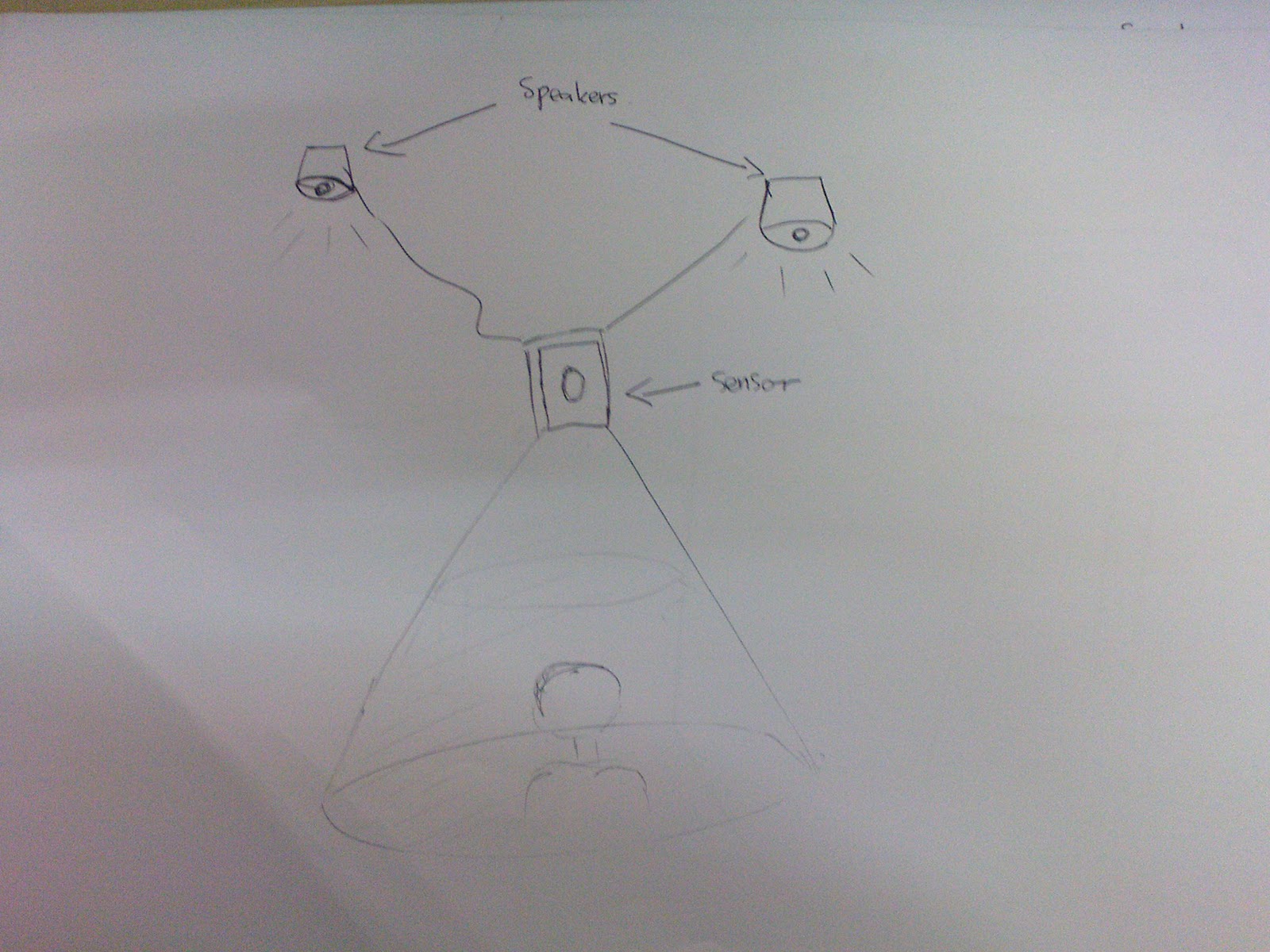
Building a sound trigger motion sensor trigger

Sketch


WEEK 5


Location

(WEEK 5 )

We plan to install our sound installation art, 'Sonance' in the female toilet near the Digtal Media studio. Below are the pictures we have taken of the location.


Project Idea Plan B

(WEEK 4)


Due to the time constraint we have for this short trimester, we have concluded that the first idea 'Illuminating Bush', had to be changed into something that was workable and researched with a short period of time.

Hence a new idea was brought up during our consultation with Mr Badrolhisham, Mr Erwin and Mr Lim Kok Yoong. 

Sonance

Theme
Sounds that cause consternation in toilets
.
Aim/Objectives
· To activate fear by sound
· To show the emotion of being in the state of fear
· To show the affection of sound

Target
The installation is intended for anyone ranging from any age, especially MMU students.


Description
Sonance is a sound installation which activates different sounds that would cause the emotion of fear in toilets. Multiple types of sounds that range from whispers, screams and foots steps are activated in different parts of the toilets to evoke the state of being feared in toilets among users. 
By playing sounds that releases the moment of being feared in toilets, users will show how they react to different types of sounds that cause fear.

Research Topic
We are trying to evoke the feeling of fear through sounds in the toilet of MMU.

Problem Identification
We find that toilets in the Faculty of Creative Multimedia could be feared among students because of the discrete location and the infrequently visits of people, making it usually empty and quiet.

Motivation
Due to the problem we have identified, we would like to evoke the affection of being scared through sounds among the user.

Ideation & Concept
To find a way to this matter, we have come up with a simple idea of playing different sounds thorough speakers and sensors that will evoke the feeling of fear.
Multiple sensors will be installed in different areas in the toilet to activate different sounds depending on the location of the user in the toilet.

Review, Analysis and Precedence Studies


This is an interactive sound installation art called 'Umbrellas' by Per Nilsson, Robert Innes and Deniz Olcay. Basically it sense motion when the user walks under the umbrella and plays a raining sound.


Tuesday, March 22, 2011

Sketch

(WEEK 4)


Mindmaps

(WEEK 4)


Project Proposal

(WEEK 3)

Illuminating Bush
Theme
To make the user feel calm during dark times.
Aim/Objectives
· To provide comfort to the user when walking in the dark
· To illuminate a pathway for the user
· To provide an interactive landscape
Target
The installation is intended for anyone ranging from any age, especially MMU students.

Description
The illuminating bush is a light installation which illuminates with LED when the user walks along the installation. The illuminating bush has motion sensors along the pathway to detect movements and illuminate light through the LED. By providing light in dark pathways, the illuminating bush can provide security in late times and can even motivate people to walk and enjoy the exciting scenery of light installation.
Research Topic
Our group would like to create the feeling of being calm and secure while walking in dark alleys or pathways in MMU.
Problem Identification
As a student in MMU for a couple of years, we have found out that MMU pathways lack of light and are normally dark eventhough there are streetlights around. Unfortunately it may be hard for students who study late at night at the library and have a strong fear of walking alone in the dark.
Motivation
Due to the problem we have identified, we would like to create a more comfortable scenery for students to walk at night in MMU.
Ideation & Concept
To find a solution to this matter, we have come up with a simple light installation using LED to illuminate walking pathways in MMU. The LED installed along the pathways would have motion sensors that would sense students walking, and would illuminate beside them as they walk along the light installation.
Review, Analysis and Precedence Studies
Dune 4.0 is a light installation designed by Daan Roosegaarde from Studio Roosegaarde which has a similar approach to creating a safer environment for pedestrians to walk in dark places. Dune 4.0 is designed to illuminate reacting to sound. As louder it sense sound around the sensor, the brighter the light will illuminate.


http://www.studioroosegaarde.net/project/dune/photo/#dune-4-0
http://www.itsliquid.com/dune-4-0.html
http://www.flickr.com/photos/studioroosegaarde/2922511198/
http://www.splitfilmfestival.hr/index.php?option=com_content&view=article&id=58%3Adaan-roosegaarde--dune-40&catid=50%3Anew-media-2008-&Itemid=128&lang=en
Design Approach
Basically our design is based on Dune 4.0's idea, but instead we will used motion sensor to make the LED illuminate.
Group Members
Muhammad Adib bin Abu Bakar 1081100853
Ahmad Shauqie bin Abdull Aziz 1081103998
Siti Fatin Sherrina binti Shaikh Zainal Abidin 1081106552